Showing posts with label National Standards. Show all posts

Thursday, 26 May 2016

National Standard in Maths after one year at school.


After one year at school, students will be achieving at early level 1 in the mathematics and statistics learning area of The New Zealand Curriculum.

The following problems and descriptions of student thinking exemplify what is required to meet this standard.

Number and algebra graphic.
Number and algebra

In contexts that require them to solve problems or model situations, students will be able to:
  • apply counting-all strategies
  • continue sequential patterns and number patterns based on ones.
During this school year, 'number' should be the focus of 60–80 percent of mathematics teaching time.

Example 1
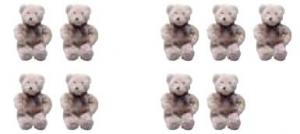
Nine teddies.
Imagine you have 4 teddies. You get 5 more teddies.
How many teddies do you have now?
The student gets the correct answer of 9 teddies by counting all of the objects: 1, 2, 3, 4, 5, 6, 7, 8, 9. They may do so by imaging the teddies, preferably, or by using substituted materials (for example fingers or counters). If they successfully use a more sophisticated strategy, such as counting on or doubling, they exceed the expectation.

Example 2

Eight strawberries.
Imagine you have 8 strawberries.
You eat 3. How many strawberries do you have left?
The student gets the correct answer of 5 strawberries by counting all the objects (1, 2, 3, 4, 5, 6, 7, 8) and then counting back (7, 6, 5). They may do so by imaging the strawberries, preferably, or by using substituted materials (for example fingers or counters). If they successfully use a more sophisticated strategy, such as immediately counting back from 8 or using known facts, they exceed the expectation.

Example 3

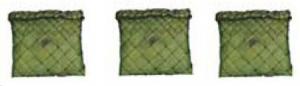
Three kete.
Here are 3 kete. There are 3 kūmara in each kete.
How many kūmara are there altogether?
The student gets the correct answer of 9 kūmara by counting all of the objects: 1, 2, 3, 4, 5, 6, 7, 8, 9. They may do so by imaging the kūmara, preferably, or by using substituted materials (for example fingers or counters). If they successfully use a more sophisticated strategy, such as skip-counting (3, 6, 9), they exceed the expectation.

Example 4

Build up the pattern below with your animal cards, one animal at a time, in front of the student.

Farm animals.
Which animal comes next in the pattern? How do you know?

The student identifies which animal comes next (the pig) by attending to its relative position in the repeating sequence: cow, pig, sheep.

Geometry and measurement graphic.

Geometry and measurement

In contexts that require them to solve problems or model situations, students will be able to:
  • compare the lengths, areas, volumes or capacities, and weights of objects directly
  • sort objects and shapes by a single feature and describe the feature, using everyday language
  • represent reflections and translations by creating patterns
  • describe personal locations and give directions, using everyday language.

Example 5
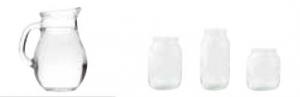
Glass jug and 3 containers.
Provide water in an ungraduated jug or bottle and 3 containers that are similar in capacity.
Use water to find out which container holds the most.
The student pours water directly from one container to another to find out which holds the most.

Example 6

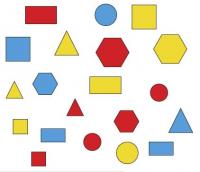
Attribute blocks.
Provide the student with a set of attribute blocks.
Sort the blocks into families.
What is the same about the blocks in each family?
The student sorts the blocks by a feature of their choice and explains their sorting. The feature may be colour, size, shape, thickness, or some other characteristic, such as number of sides, symmetry, 'pointiness', or 'roundness'.

Example 7

Sit with the student at their desk in the classroom.
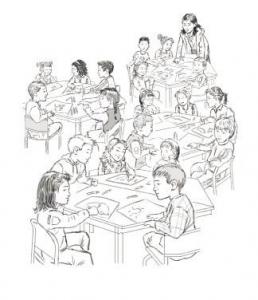
Drawing of kids in class.
Imagine I am standing at the door. I need to get to where Rawiri sits. Tell me how to get to his seat.
The student gives clear directions that lead you to Rawiri’s seat. They may tell you to move backwards or forwards and to turn right or left. If the student specifies distances in steps or metres or uses half- or quarter-turns, they exceed the expectation.

Statistics graphic.
Statistics

In contexts that require them to solve problems or model situations, students will be able to:
  • investigate questions by using the statistical enquiry cycle (with support), gathering, displaying, and/or counting category data.

Example 8
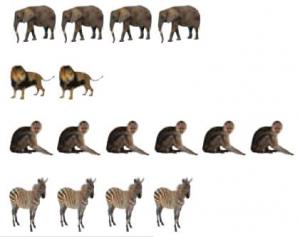
Jungle animals.
Provide the student with the animal cards shown, randomly arranged.
Arrange the cards so that someone else can see how many of each animal there are at the zoo. How many zebras are there? Which animal is there most of?
The student sorts the animals into categories and displays the number of animals in each category, using a set grouping or pictograph as above. They correctly answer that there are 4 zebras and more monkeys than any other animal.


How to help at home.
  • find numbers around your home and neighbourhood – clocks, letterboxes, speed signs
  • count forwards and backwards (clocks, fingers and toes, letterboxes, action rhymes, signs)
  • make patterns when counting "clap 1, stamp 2, clap 3, stamp 4, clap 5…"
  • do sums using objects such as stones or marbles eg 2 + 3, 4 +1, 5 + 4
  • make up number stories – "you have 2 brothers and 2 sisters. There are 4 of them"
Here's a tip - maths is an important part of everyday life and there are lots of ways you can make it fun for your child.

Use easy, everyday activities

Involve your child in:
  • preparing and sharing out food – "two for me and two for you". Ask, "How many for each of us?"
  • talking about time – "lunchtime", "storytime", "bedtime"
  • using words in everyday play like "under", "over", "between", "around", "behind", "up", "down", "heavy", "light", "round", "circle", "yesterday", "tomorrow". You can get library books with these words and ideas in them too
  • asking questions like "How many apples do we need for lunches? What do you think the weather is going to be like today/tomorrow? What are we going to do next?"
Here's a tip - use lots of mathematics words as your child is playing to develop their understanding of early mathematics (eg "over", "under", "first, second, third", "round", "through", "before", "after"). Use the language that works best for you and your child.

For wet afternoons/school holidays/weekends

Get together with your child and:
  • play with water using different shaped containers and measuring cups in the sink or bath
  • bake – talk to your child about the recipe/ingredients using words like "how many?" "how much?" "more". Count how many teaspoons of baking soda are needed, how many cups of flour, how many muffin cases
  • play dress-ups and getting dressed, use words like "short", "long", and ask questions like "what goes on first?", "what goes on next?", "does it fit?"
  • create a ‘sorting box’ with all sorts of ‘treasure’ – bottle tops, shells, stones, poi, toys, acorns, pounamu (greenstone), cardboard shapes, leaves. Ask questions like "how many?", "which is the biggest group?", "which is the smallest?", "how many for each of us?"
  • do jigsaw puzzles, play card and board games and build with blocks.
Here's a tip - being positive about mathematics is really important for your child’s learning – even if you didn’t enjoy it or do well at it yourself at school.


National Standard in Writing after one year.

The writing standard

After one year at school, students will create texts as they learn in a range of contexts across the New Zealand Curriculum within level 1. Students will use their writing to think about, record, and communicate experiences, ideas, and information to meet specific learning purposes across the curriculum.

Key characteristics of students' writing at this level

Students will plan for writing, using talk or pictures. They will independently write simple texts, drawing on the knowledge, skills, and attitudes that will help them achieve their purpose. The knowledge, skills, and attitudes expected at this level, including those needed for spelling and punctuation, are described in the Literacy Learning Progressions.
The texts that students write will include, when appropriate:
  • an idea, response, opinion, or question
  • several sentences (including some compound sentences with simple conjunctions such as 'and')
  • some key personal vocabulary and high-frequency words
  • attempts at transferring words encountered in the writer's oral language or reading to their writing.

Illustrating the writing standard

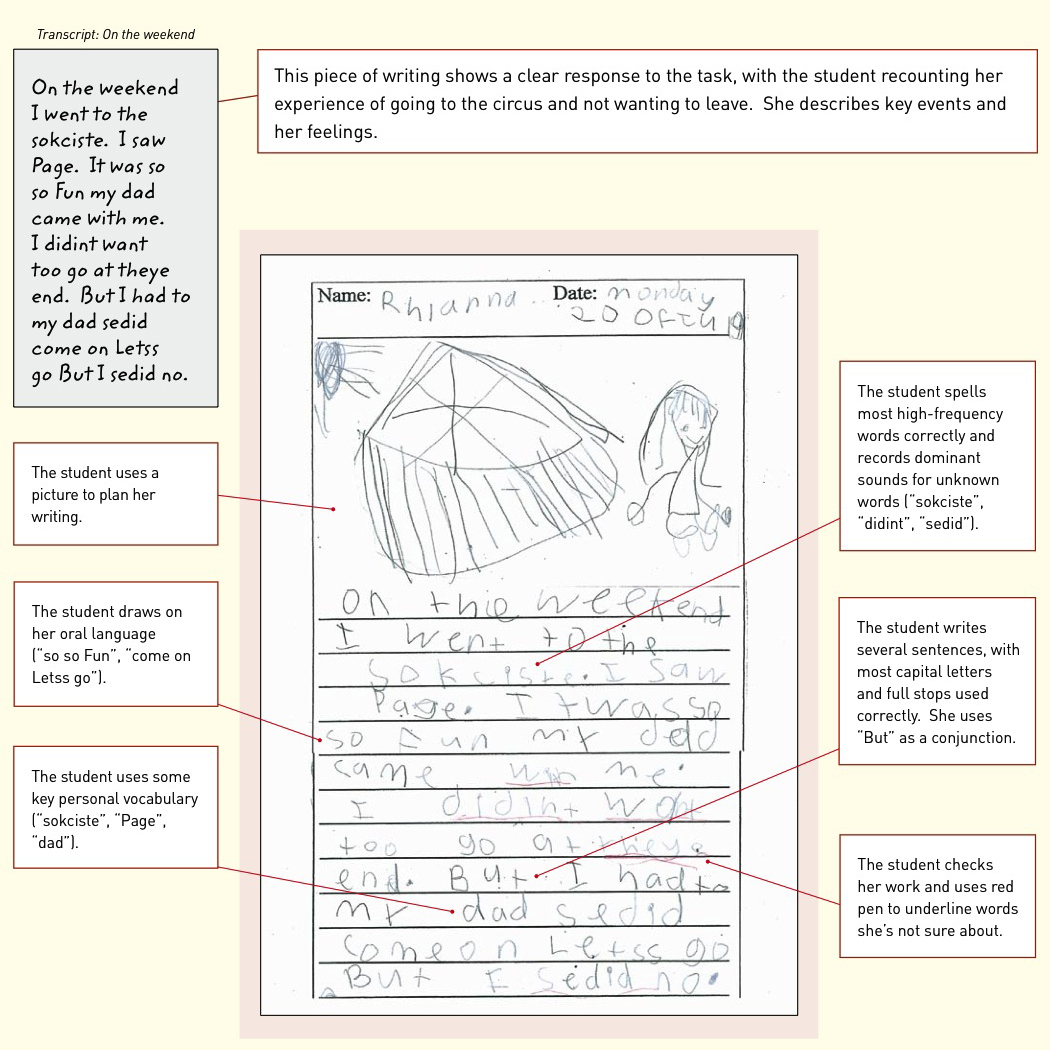
On the weekend
The task exemplifies the writing demands of the English curriculum within level 1.
The students have been writing independently about their favourite holiday activity. They have been asked to plan, write, and then check their work.
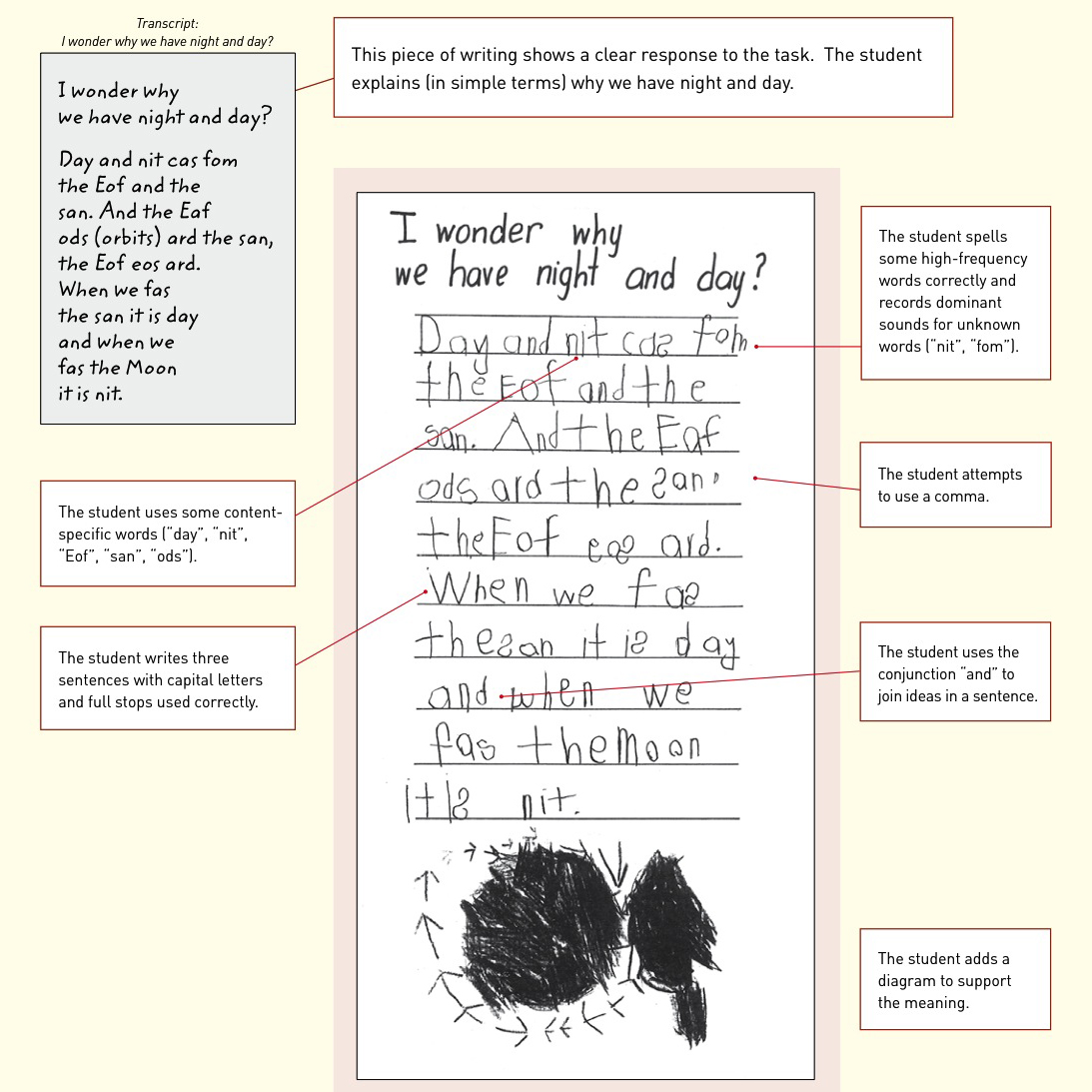
This is the student’s first draft. Features of the writing that demonstrate the standard are described below.
This example illustrates the sorts of writing that teachers can expect of students who are meeting the standard. To meet the standard, students draw on the knowledge, skills, and attitudes for writing described in the Literacy Learning Progressions for students at this level.

I wonder why we have night and day?
The task exemplifies the writing demands of the English and science curriculum learning areas within level 1.
The students have been asked to write an explanation to answer the question 'I wonder why we have night and day?' The teacher has supported the students in this task by having them practise giving oral explanations on a familiar topic and by building their understanding of the topic through a variety of practical activities. The teacher has also provided appropriate reference materials and has explicitly taught relevant vocabulary.
This example illustrates the sorts of writing that teachers can expect of students who are meeting the standard. To meet the standard, students draw on the knowledge, skills, and attitudes for writing described in the Literacy Learning Progressions for students at this level.


Writing at home

Make writing fun

  • Help your child write an alphabet letter, then go letter hunting in your house or in a book to find that letter
  • Let your child see you writing – you can use your first language
  • Encourage them to write shopping lists or make birthday cards
  • Water and a paintbrush on a dry path and a stick on sand are fun ways to write letters and words.
Here's a tip - Don’t worry if your child’s letters or words are sometimes backwards or misspelt at this age. The important thing is that they have fun writing at home and are making an effort.

Give them reasons to write

  • Write to each other. Write notes to your child and leave them in interesting places, like their lunch box. Ask them to write a reply
  • Help them email, text or write to family, whānau or friends
  • Work with them to put labels on special things – like the door to their room or their toy box.
Here a tip - display their work. Put it on the fridge. Be proud of it. Share it with others.

Talk about their writing

  • Talk about the letters in your child’s name and where the name comes from.
  • Help them create a scrapbook with pictures. Encourage them to write stories under the pictures and talk to you about them.
  • Ask them to write about pictures they draw - on paper or on the computer. Or get them to tell you the story and you write it under the picture.
Here's a tip - talk about what your child writes. Be interested. If you don’t understand what your child’s picture or story is about, ask them to tell you about it.

Encourage writing


  • Have felt pens, pencils, crayons and paper available
  • Put magnetic letters on the fridge – ask what words they can make with the letters.

National Standard in Reading after one year at school

Year 1 enclosed in a circle.


The reading standard

After one year at school, students will read, respond to, and think critically about fiction and non-fiction texts at the green level of Ready to Read (the core instructional series that supports reading in The New Zealand Curriculum).

Key characteristics of texts at green level

Texts at green level have been designed with characteristics that include:
  • generally familiar contexts and settings
  • one text form, and one main storyline or topic, for each text
  • most content explicitly stated but also some implicit content that provides opportunities for students to make simple inferences
  • illustrations that support and extend the meaning but may not exactly match the words
  • many high-frequency words
  • topic words and interest words (including a wide range of regular and irregular verbs and some adjectives and adverbs) that are likely to be in a reader's oral vocabulary and that are strongly supported by the context or illustrations
  • some visual language features such as diagrams or speech bubbles
  • sentences that run over more than one line but do not split phrases
  • dialogue between easily identified speakers
  • a range of punctuation, including speech marks and commas, to support phrasing and meaning.
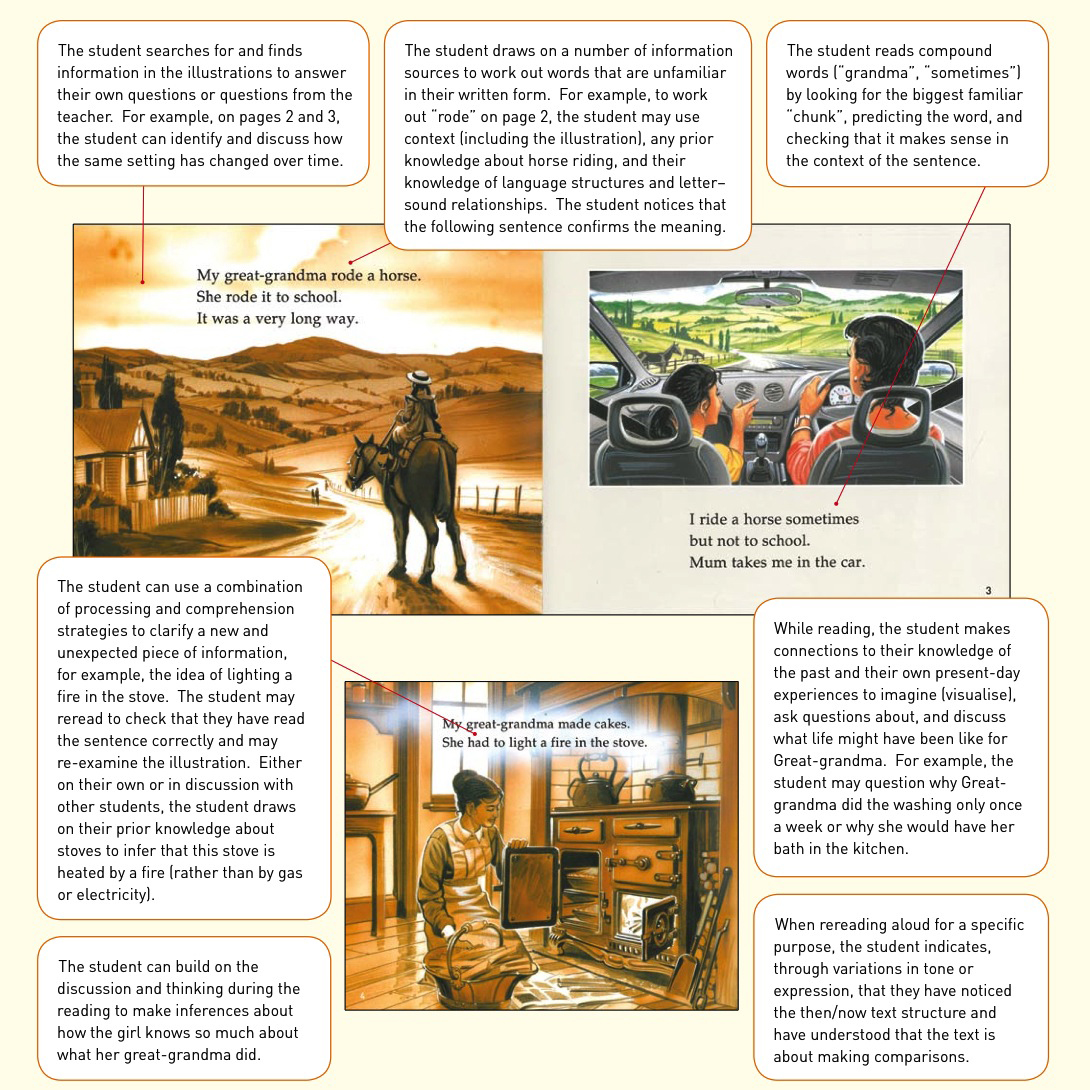
These characteristics support the development of reading behaviours that are illustrated here.